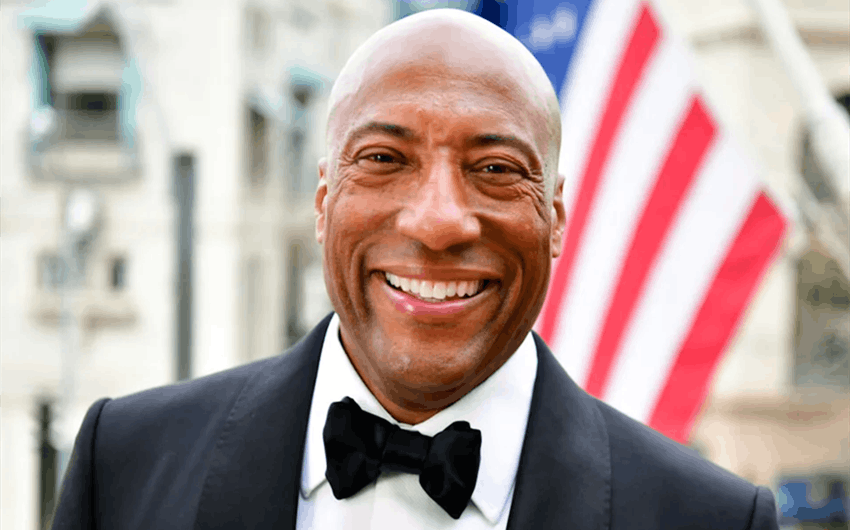
Byron Allen Biography: Media Mogul’s Age, Height, Wife, Kids, Net Worth, Career
Byron Allen is one of the most quietly powerful media owners in America—an entrepreneur who went from teen stand-up comic to building a company that buys TV networks, broadcast stations, and massive libraries of content. This byron allen biography covers the basic facts people look for first, then explains how he turned hustle, syndication strategy, and aggressive dealmaking into a billion-dollar media empire.
Basic Facts About Byron Allen
- Full name: Byron Allen Folks
- Known as: Byron Allen
- Born: April 22, 1961
- Birthplace: Detroit, Michigan, USA
- Age: 64 (as of January 2026)
- Height: Commonly reported around 5 ft 8 in (about 1.73 m), though not officially confirmed in every profile
- Nationality: American
- Profession: Media executive, producer, former stand-up comedian
- Company: Founder, Chairman, and CEO of Allen Media Group (formerly Entertainment Studios)
- Wife: Jennifer Lucas (married in 2007)
- Children: 3 (two daughters and one son)
- Estimated net worth: About $1 billion (estimated; varies by source)
Early Life: Detroit Birth, Los Angeles Dreams, and a Front-Row Seat to Television
Byron Allen was born in Detroit in 1961, but the most important part of his early story happened after he moved to Los Angeles with his mother, Carolyn. His upbringing wasn’t the classic “born into Hollywood” situation. It was closer to a determined parent working hard while a talented kid tried to find an opening.
One of the most repeated details in Allen’s early biography is that his mother worked at NBC in Los Angeles. That placed him near studios and real television professionals at a time when most kids only saw TV from the couch. Allen has described those early years as a kind of informal education—watching how broadcasting worked, how talent was treated, and how the business decisions behind the scenes shaped what the public eventually saw.
That proximity also gave him something else: confidence. It’s easier to imagine yourself in a world when you’ve already walked its hallways.
Teen Stand-Up: How Comedy Opened the First Door
Allen started performing stand-up comedy as a teenager—young enough that most people are still figuring out who they are, let alone building a professional skill. Comedy is a brutal teacher. If you’re funny, the room rewards you immediately. If you aren’t, the room lets you know just as fast.
His early talent led to major opportunities, including appearances connected to late-night television. That mattered because late-night stand-up has long been a shortcut to national recognition. But in Allen’s case, comedy wasn’t the final goal. It was the entry point—his way into show business before he had power, money, or a company name behind him.
What separated him from many comedians is that he seemed to be watching the industry as much as he was performing in it. Plenty of funny people chase fame. Allen chased ownership.
Breaking Into TV: “Real People” and Learning the Industry From Inside
Allen’s early television career included work as a co-host on the NBC series Real People. That experience gave him something comedians rarely get early: steady exposure to TV production rhythms and the realities of network broadcasting.
Hosting and appearing on TV teaches you what the camera needs, how producers think, and how distribution works. It also teaches you how fragile a “talent-only” career can be. Shows change. Trends shift. Networks replace personalities quickly. For someone with Allen’s mindset, the lesson is obvious: if you want stability, you build something you own.
The Pivot That Defined Him: Building a Media Company Instead of Chasing Roles
By the early 1990s, Allen made the move that would define his reputation. Instead of treating entertainment as a ladder of gigs, he treated it as a business to build. He founded what became Entertainment Studios in 1993, which later evolved into Allen Media Group.
On paper, the idea sounds simple: produce and distribute content. In reality, it’s one of the hardest businesses in the world because distribution is power. If you can’t get shows onto networks, or you can’t get channels onto cable systems, it doesn’t matter how good your content is.
Allen’s approach was different from the traditional Hollywood path. He focused on building a large volume of programming and controlling the pipeline. Over time, this turned into a “stacked” business model: produce shows, distribute shows, own networks, then expand into broadcasting and digital platforms. That kind of vertical integration is how major media dynasties are built.
Allen Media Group: What He Owns and Why It Matters
Allen Media Group is often described as a portfolio company—meaning it isn’t built around one flagship product. It’s built around a network of channels, stations, and content libraries that work together.
According to the company’s own overview, Allen Media Group (and its Entertainment Studios roots) operates as a global production and distribution business with multiple HD networks and large programming output. The bigger point is not the exact channel count on any given day. The point is that Allen built a system where content can be created, packaged, distributed, and monetized under one umbrella.
This is why Allen is frequently called “under-the-radar.” If you don’t follow media ownership, you might not realize how many places his company appears. But ownership isn’t always loud. Sometimes it’s everywhere quietly.
The Weather Channel Deal: A Signature Acquisition
One of Byron Allen’s most headline-making purchases came in 2018, when his company acquired The Weather Channel’s TV network for about $300 million. For many media observers, that deal was a statement: Allen wasn’t just producing syndicated shows—he was buying major American television brands.
The Weather Channel also fit his larger strategy. Weather content is evergreen. It’s always needed, always watchable, and highly valuable to advertisers. Even as entertainment trends change, weather remains a daily utility. That kind of asset can stabilize a media portfolio during chaotic market cycles.
Broadcast Expansion: Owning Local TV Stations (and Selling Some Later)
Allen Media Group expanded heavily into broadcast television stations, buying local affiliates in different markets. Local stations are not glamorous like movie studios, but they can be financially powerful because they deliver local news, syndicated programming, and network content to consistent audiences.
In recent years, however, the local TV business has faced major pressure: shifting ad markets, cord-cutting, and higher financing costs. In 2025, Gray Media agreed to acquire Allen Media Group stations in 10 markets for $171 million, with reports describing the deal as part of broader restructuring and station divestitures.
This doesn’t mean Allen “failed.” It means he operated like a dealmaker. Media owners buy, consolidate, refinance, and sometimes sell parts of a portfolio to reposition for the next cycle. That’s what real media empires do—move pieces around the board.
The Meteorologist Controversy: Centralizing Weather Coverage
Allen’s ownership of The Weather Channel became even more connected to his local station strategy when reports described local meteorologists being replaced or reduced as stations shifted toward centralized weather segments and feeds. The story drew attention because local weather is one of the main reasons many viewers still watch local news.
From a business perspective, centralizing weather coverage can reduce costs and create consistent branding. From a community perspective, it can feel like losing a familiar, trusted local voice. This moment highlighted something important about Allen’s leadership style: he’s willing to make controversial operational decisions if he believes they strengthen the business model.
High-Profile Bids: Paramount and the “Go Big” Reputation
Byron Allen has also become known for bold acquisition attempts aimed at major legacy media companies. In January 2024, reports said he made a $14.3 billion offer for Paramount Global’s outstanding shares, with the total transaction value rising to about $30 billion when debt was included. Whether or not a deal like that closes, the signal is clear: Allen wants to play at the highest ownership level.
These bids reinforce his public identity as a modern media consolidator—someone who sees opportunity in legacy assets at a time when traditional media is under pressure. When some buyers retreat, he often leans in.
Lawsuits and Business Activism: The McDonald’s Settlement
Allen has also been highly visible in the corporate legal arena, particularly around advertising access and discrimination claims. In 2025, McDonald’s settled a discrimination lawsuit filed by Allen for an undisclosed amount, shortly before the case was scheduled to go to trial.
These legal battles became part of his broader brand: not only a buyer and builder, but also a businessman willing to use the court system as leverage when he believes major corporations are shutting out Black-owned media.
Wife and Marriage: Who Is Jennifer Lucas?
Byron Allen is married to Jennifer Lucas, a television producer and executive. They married on September 1, 2007, in a ceremony widely reported as taking place at the Hotel Bel-Air in Los Angeles.
Lucas is often described as someone who understands entertainment from the inside, which matters in a relationship where the spouse’s “job” is also a lifestyle. Media ownership is nonstop—meetings, deals, travel, negotiations, crisis management, and publicity. A partner who understands the industry can make the personal side steadier.
Children and Family Life
Byron Allen and Jennifer Lucas have three children—two daughters and one son. Their children’s names are commonly reported as Chloe Ava, Olivia Rose, and Lucas Byron. Compared to many celebrity families, they tend to keep daily family life relatively private, but they do appear publicly at major events from time to time.
Allen’s public image is heavily business-focused, yet family is consistently part of his biography because it reflects stability behind the scenes. He’s not only building a company. He’s building a legacy that, like most billionaire stories, is partly about what lasts beyond one career chapter.
Real Estate and Lifestyle: Quiet Luxury at the Highest Level
Allen’s wealth has also shown up in real estate reporting. In 2025, The Wall Street Journal reported that he sold a full-floor condo at 220 Central Park South in Manhattan for $82.5 million—one of the most expensive New York City deals of the year. Reports have also linked him to other high-value properties, including estates in Malibu and additional luxury holdings.
Real estate isn’t only about lifestyle in his case—it’s often part of how ultra-wealthy individuals diversify assets. But it also reinforces the “billionaire reality” of his story. He’s not playing the role of a mogul. He lives like one.
Net Worth: How Much Is Byron Allen Worth?
Byron Allen’s exact net worth is not publicly confirmed through audited financial statements because Allen Media Group is privately held. That means any number you see is an estimate based on deal values, reported assets, and company valuations.
Still, the most widely circulated public estimate places his net worth at around $1 billion. That estimate fits his profile as a major media owner with valuable networks, local station assets (even after partial sales), production and distribution businesses, and significant real estate.
The key takeaway is simple: Byron Allen is widely considered a billionaire, and his wealth is tied primarily to ownership—owning the company, owning the networks, owning distribution, and owning assets that produce ongoing revenue.
Why Byron Allen’s Story Is Different
Many entertainment success stories are built on celebrity—being the face people recognize. Allen built his success on infrastructure. He learned early that being on camera is not the same as owning the camera. That mindset shaped everything.
His career also challenges a common assumption: that the only way to win in Hollywood is to be loudly famous. Allen is famous, but his power has often been quieter than his peers. He shows up in deal headlines, not tabloid stories. And while many entertainers peak and fade, he kept expanding—channel by channel, station by station, acquisition by acquisition.
Whether you admire his approach or criticize parts of it, the business result is undeniable: he became one of the few Black media owners operating at the level where billion-dollar conversations are normal.
The Legacy: What Byron Allen Represents in Modern Media
Byron Allen represents a rare kind of modern mogul: a person who understands both content and the pipes that carry content. He started with comedy, learned television from the inside, then built a company that competes in an industry dominated by legacy giants.
His story is also a reminder that media is still a power business. Owning channels, stations, and distribution changes how narratives move through the culture. That’s why Allen’s deals, lawsuits, and acquisition attempts matter beyond money. They reflect who gets to own platforms—and who gets to decide what the public sees.
If his next decade includes more acquisitions, restructurings, and bold bids, it will be consistent with everything he has already shown: Byron Allen doesn’t treat media as entertainment alone. He treats it as territory.
image source: https://www.yahoo.com/entertainment/articles/byron-allen-plus-know-10-171028241.html